
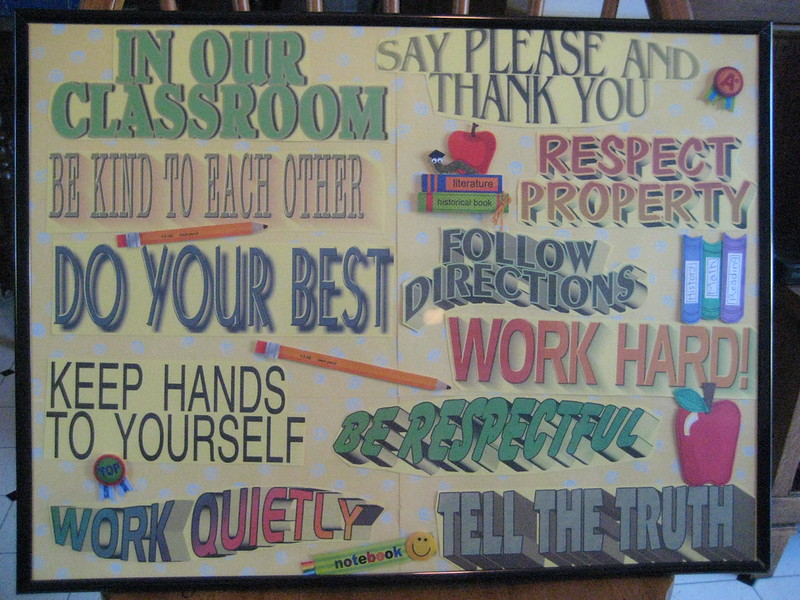
Classroom poster from Flickr user BarbaraLN https://www.flickr.com/photos/46097950@N02/7687402370
The Four Agreements by Don Miguel Ruiz uses ancient Toltec wisdom to map your way to peaceful consciousness. It is not concerned with your soul in the afterlife; it explains how to have peace here and now, free from psychological suffering.
The Interior Castle by Saint Teresa of Avila is equally concerned with giving you peace here and now, but it is predicated on the belief that when we pass away, our souls must be intact so we can return to God.
In the interest of learning to agree with one another in 2026, I have chosen these two books from my collection to compare and contrast because they both led me to the same conclusion: personal responsibility leads to a life of peace.
Ruiz says: be impeccable with your word, don’t take anything personally, don’t make assumptions, and do your best. In doing so, you control your authentic identity, live without fear and shame, and therefore create your own “heaven on earth.”
St. Teresa says your soul is like a crystal castle with seven inner mansions – each mansion a deeper level of awakening – that becomes purified through prayer and humility, until it is worthy of union with God. If this is your goal, then your outward life aligns and you become a peaceful, patient person unfettered by the “reptiles” and “very venomous creatures” that lurk in the outside world. (Bible folk really seem down on reptiles, and I apologize to the reptile community).
Each author is telling you that personal responsibility is freedom. When you engage in the four agreements, you worry nothing of scorn, slander, attack, or fear. When you care about keeping your soul intact, you do not invite venomous creatures to dismantle your peaceful life. Sure, the venomous try, but here again – remember our elementary days: ” I’m rubber, and you’re glue. Whatever you say bounces off me and sticks onto you.”
But how do you know if you’re a good person? Your first clue: You’ve asked the question. In all teachings, whether it’s faith, Toltec wisdom, Stoicism, or Barbara’s classroom poster at the top of this article, it always comes back to intent, accountability, and repair. A brief checklist:
- You take responsibility and make amends for hurting someone.
- You do the right thing when no one is looking.
- You don’t take what doesn’t belong to you.
- You treat people well, even when they cannot ‘benefit’ you, and you don’t punch down.
- You use your advantages to help others.
- You have a healthy amount of guilt, empathy and reflection (I said HEALTHY).
- You regret your white lies, even though they were tethered to a complex problem involving manners or safety. You don’t construct horrible, false lies out of nowhere designed to hurt someone or take what doesn’t belong to you.
- You’ve read this article up to here, looking for the answer.
Perhaps a deluge of regret will follow now that you’ve read this. You’ll look back on things you weren’t proud of, or things you wish you’d never done. It’s ok. Don’t drown in that. I’m not here for the shaming. I’m here to set you free.
None of us are perfect. If we were, this whole human experiment would end, and we’d morph into the next thing. The alien ships would land and we’d pack up and go home. So I think better questions are:
- As we journey through life, are we growing in empathy, accountability, honesty and integrity?
- Do our words creating suffering or peace?
- Do we become more humble, loving and illuminated?
- Are we living according to what we deem virtuous despite our struggles?
- Are we following Barbara’s poster?
Call it soul, call it consciousness, call it your moral code. I don’t care – just make sure you call it.
Until next time, Let nothing disturb you, Let nothing frighten you, All things pass away; God (Source, Physics) never changes. Patience obtains all things. They who have God (Source, Physics) find they lack nothing; God (Source, Physics) alone suffices.
Love, Jen